• Skip to primary navigation
  • Skip to main content
  • Skip to footer

Stickytapeandstring

Created with WordPress managed by 1&1

  • Craft projects
    • craft business tips
    • craft blog
    • Crochet patterns
    • Upcycling
    • craft with kids
  • Blogging
    • New to blogging
    • Blog diary
  • Bullet Journal
  • About me
  • Welcome!!

A_Sticky_tape_and_string_girl

Yarn Salvage #3 – how best to use the yarn

April 27, 2019 by A_Sticky_tape_and_string_girl Leave a Comment

Yarn recycling is fun, rewarding and good for the planet! In my two earlier posts I gave you tips on garment selection and salvage. Yarn Salvage #3 – How best to use the yarn….. will give more advice on how to process the yarn you collect and the best way to use the yarn. You can see the earlier posts here Yarn Salvage Tips #1 and Yarn Salvage Tips #2

There are a number of different aspects to yarn that influence how you treat it and the type of project it is suited to. The three main aspects I will cover here are yarn weight, ply and content.

Yarn Weight – wpi

This is an important aspect of the yarn when it comes to determining the type of project you can use the yarn for. We measure Yarn Weight in ‘wraps per inch’. You can pay a lot of money for a gadget that works out the wpi for any yarn. It really isn’t difficult though and in my view not worth spending hard earned cash on! Wraps per inch is the number strands of yarn that will fit into one inch. The strands should sit next to each other comfortably. There should be no overlap or stretch.

To make your own gadget to measure wpi you need a pen, ruler and piece of wood – ideally something rounded like a broom handle. We use an old clothes peg 🙂

Take the ruler and place two marks on the wood one inch apart. Draw lines around the wood at the places you have marked. You are already ready to use the tool!

Take the yarn you want to assess and wrap it around the tool. Place the first strand of yarn just inside the first mark you made. Wind the yarn round the tool without stretching the yarn. Each strand of yarn should sit alongside the previous strand with no overlap. When the yarn wrapped around the tool reaches the second mark, stop winding. Count the number of wraps of yarn between the two markers. This is your wraps per inch for the yarn or wpi.

Yarn Ply

Ply is the number of individual strands that make up a yarn. Sometimes the strands are twisted so that the yarn handles as one strand. Sometimes you unravel a garment and find that the yarn is made up of several strands that have not been twisted. You can choose whether to separate out the strands or keep the yarn as multi-strand. What you choose to do will depend on the type of yarn and the type of project you want to use it for. I keep detailed records of recovered yarn. I write down the wpi and where the strands are not twisted, also note the ply. This gives me good information when planning projects.

Yarn content

The easiest way to identify the yarn content is to take the information from the garment label when you recover the yarn. I try to select garments with an element of natural fibre. When combining yarn in a project I try to match fibre types. This is not always possible. Yarn content will impact the way the yarn changes over time. It will also have a big impact on the way the yarn washes. If you have a project made from recycled yarn always wash on a wool/cool setting and dry flat. This is particularly important when combining more than one salvaged yarn.

Unravelled yarn often has a lot of ‘kinks’. When you crochet or knit with the yarn these kinks will disappear. If they bother you you can try to reduce them. I say ‘try’ because this method will produce varied results according to the yarn composition. The lower the percentage of natural fibre the less effective this method will be.

Flattening kinks in yarn containing natural fibres

Firstly, turn the yarn into hanks rather than balls. There are expensive machines that make this job easier but we are trying to save cash! You can wind yarn into hanks using your own arm winding the yarn between the base of your thumb and elbow. You can also use the back of a chair or enlist the help of a small human! I find small humans to be helpful and compliant until they hit teenage years. Teenagers are less than inspired by the idea of helping wind yarn 🙂

Once the yarn is in hanks soak them in warm water – NOT HOT (unless you want to end up with felt). You can add wool washing liquid or powder. The kinks should begin to relax in the water. You may have to leave the yarn soaking for a few hours. Rinse and dry the yarn either flat on a towel or hanging over a bath. Do not squeeze or ring out the yarn. Finally you will need to reball the yarn for use.

Using the recycled yarn

Now you have added all this recycled yarn to your stash what will you make? It is possible to use the yarn recovered from one garment to make another garment. However, it is likely that during the recovery process some yarn will have been lost. This means that you might need to top up the quantity of yarn from one garment in order to have enough to make another.

You can top up the recovered yarn with yarn from your stash. You could buy some yarn to contrast or compliment the recovered yarn. Or you could combine different yarns that you have recovered into one project.

Most patterns are designed for yarn of a particular weight or wpi as above. One of the latest patterns I wrote was for a super chunky yarn worked up on a 9mm hook. I wanted something that would grow and complete quickly! I decided to use this pattern as an example of how I work with recycled yarn.

Much of the yarn I salvage has a high wpi. This is because most yarn used in the industrial manufacture of garments is lightweight around 14 wpi. I prefer to work with a heavier yarn, aran or chunky weight around 7 or 8 wpi. However, you can combine the yarns you recover to produce a heavier weight yarn. This is what I did in my latest project. The resulting yarn can look startling different to its component parts.

Hearts and Stripes Recycled Blanket

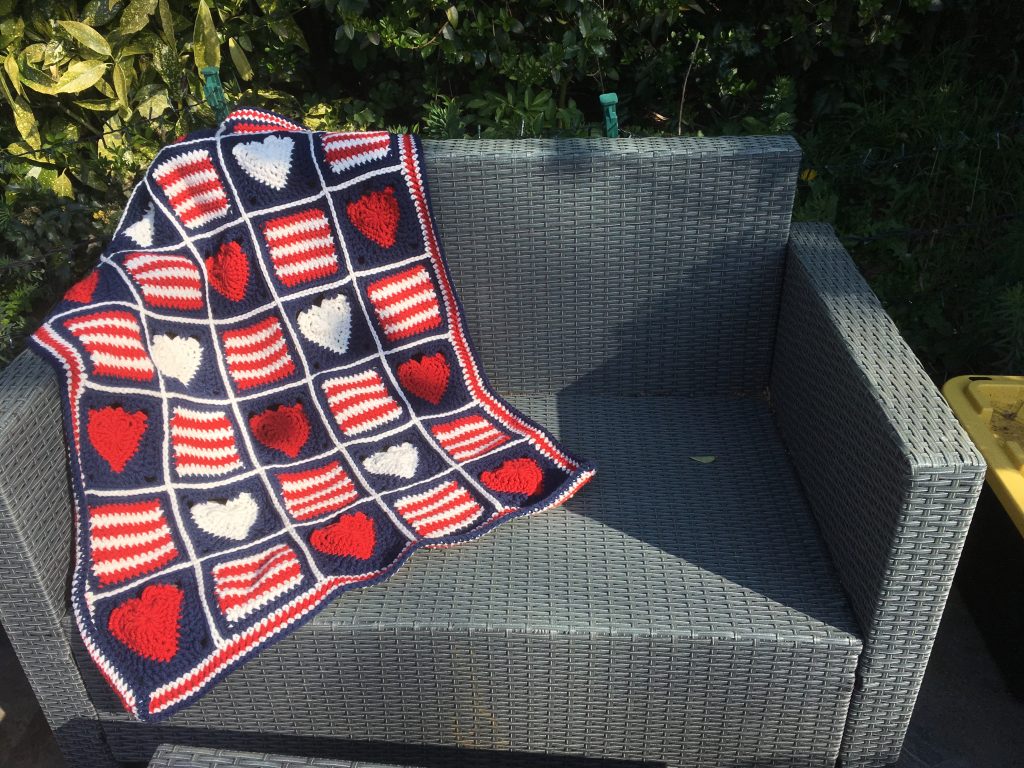
Here is my recycled project. The pattern is one I designed myself and is available for free here. The yarns I used are different ply and composition but worked up very easily as one yarn. Remember to test the wpi of your combined yarn before starting the project. I expected the crochet to be difficult and that the yarn would split but this was not the case. Finishing off the ends was the only part that I found more difficult but with a little extra patience and care even that was not too much of a challenge. Here are the recycled yarns I started with.
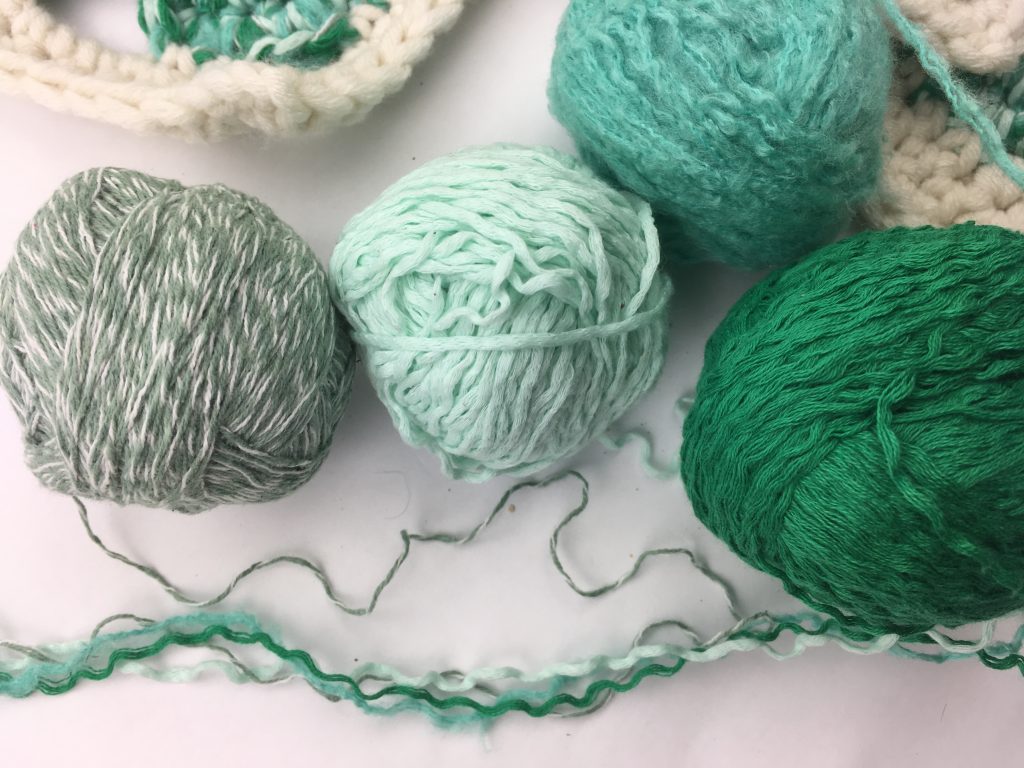
Salvaged yarn

I combined the recycled yarn with some super chunky white yarn from my stash. This was left over from a previous project. As you can see the finished result looks quite different to the four yarns that went into the work.
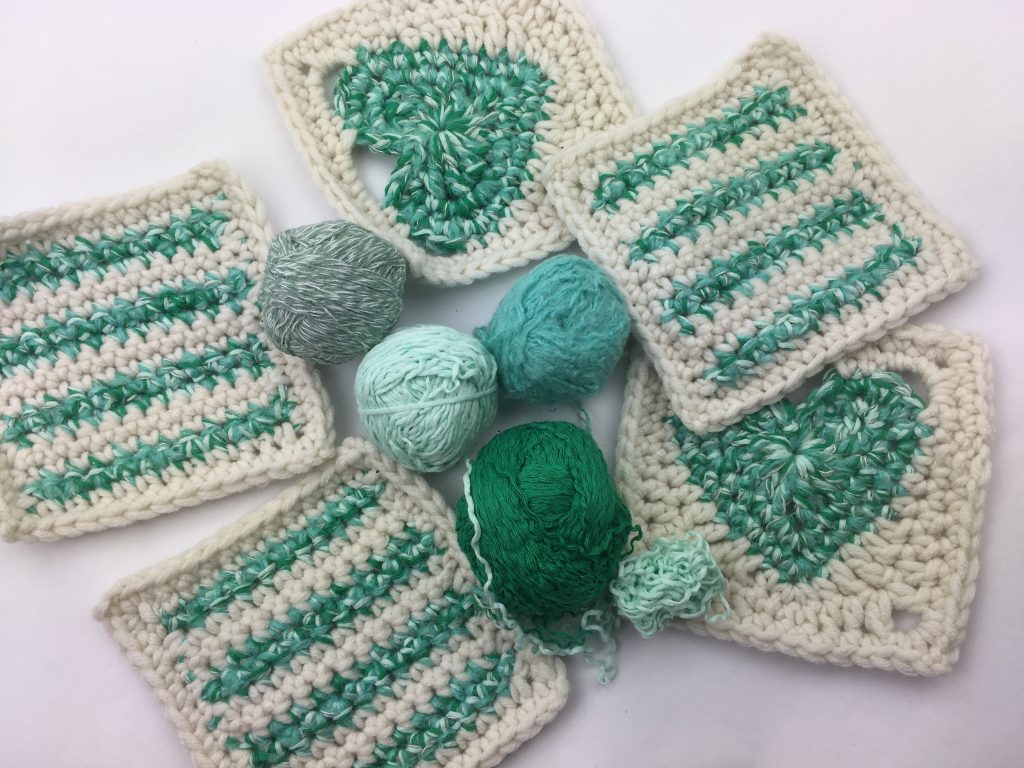
yarn salvage - how best to use the yarn

There are many ways to choose yarn for your projects. For me, there is nothing better than laying out all the balls of recovered yarn on the floor and playing with the colour combinations. This is how I get inspiration for my next project. Group the yarn by colour and see what works! Happy recycling!!

Annie 🙂
Filed Under: Uncategorized, Upcycling Tagged With: crochet blanket, recycling, recycling yarn, super chunky yarn, yarn, yarn combining, yarn salvage

Hearts and Stripes blanket

April 27, 2019 by A_Sticky_tape_and_string_girl Leave a Comment

Hello ?here is my latest project – Hearts and Stripes Blanket. This pattern is based on the heart motif I created last year. For this project I wanted to produce a solid version of the heart square. To make a heavy duty lap blanket quickly! I used super chunky yarn and a 9mm hook. With this yarn I can easily make one of these blankets in a week or two.

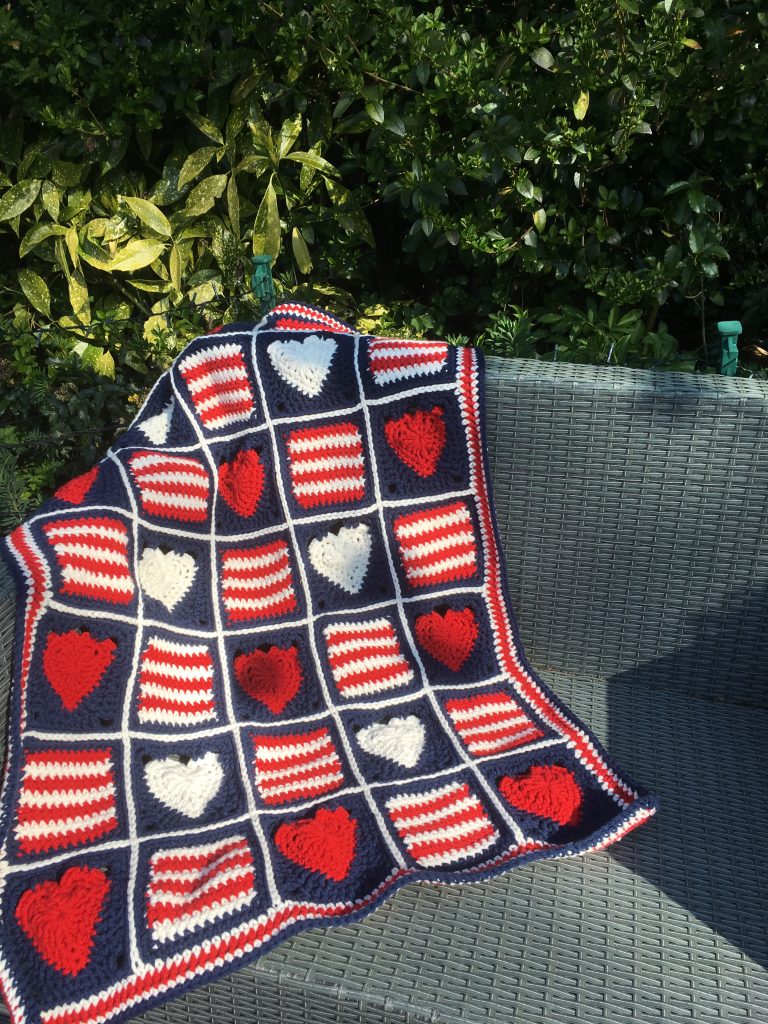
Here is the finished blanket worked up in red white and blue yarn. You can use the blocks to make a blanket of any size. If you use a lighter weight yarn you will probably want to put in more blocks. I went for a seven by five block layout as that worked best for the quantity of yarn I had. The finished blanket measures about 34 inches by 48 inches or 85cm by 125cm in metric.

Hearts and Stripes Blanket

This pattern would also work very well as a stash-buster project. The yarn required for each area of colour is quite small. I salvage quite a lot of yarn and often end up with a large number of smaller balls of yarn. You can read my top tips for yarn salvage here.

The pattern took four 100g balls of the navy and 3 of each of the red and white.

The blanket pattern is made up of striped squares and full heart blocks. The pattern for the heart block in both UK and US terms are available here

The instructions for the striped block are here again in both UK and US terms.

Joining the Blocks to make the blanket

The blanket is made up of these two blocks worked in a seven by five alternating pattern. The join I used for this blanket is one that has minimal finishing off. The technique makes a feature of the joining thread.

Line up two squares edge to edge with the right side of the work facing up.

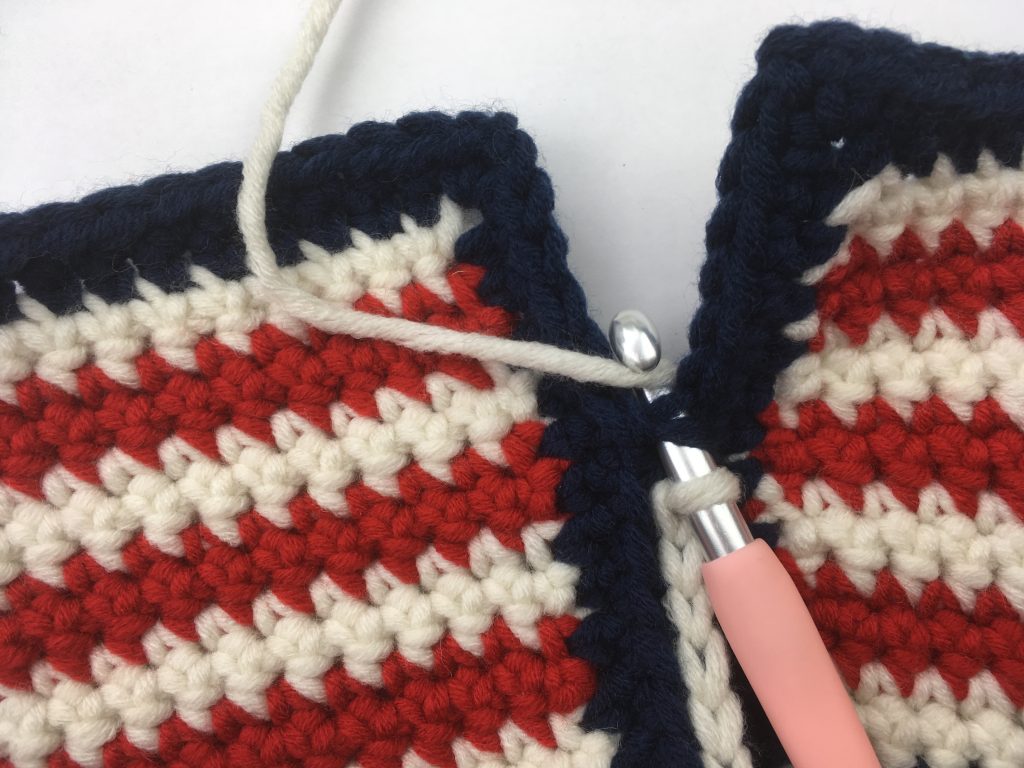
Place the yarn you are using for the join behind the work. Always keep the joining yarn behind the squares. Pick up stitches from the back of each of the two edges, as shown below.

Joining instructions 1 - Hearts and Stripes Blanket

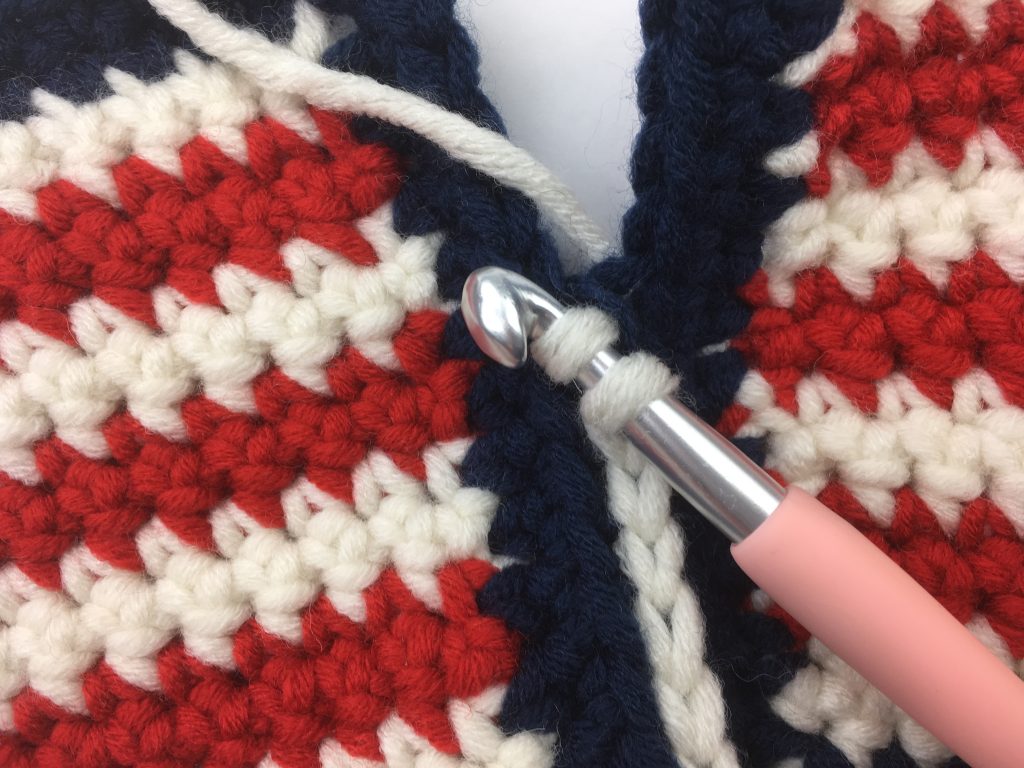
Wrap the yarn round the hook working from behind. You need to keep the yarn behind the work at all times.

Joining instructions 2 - Hearts and Stripes Blanket

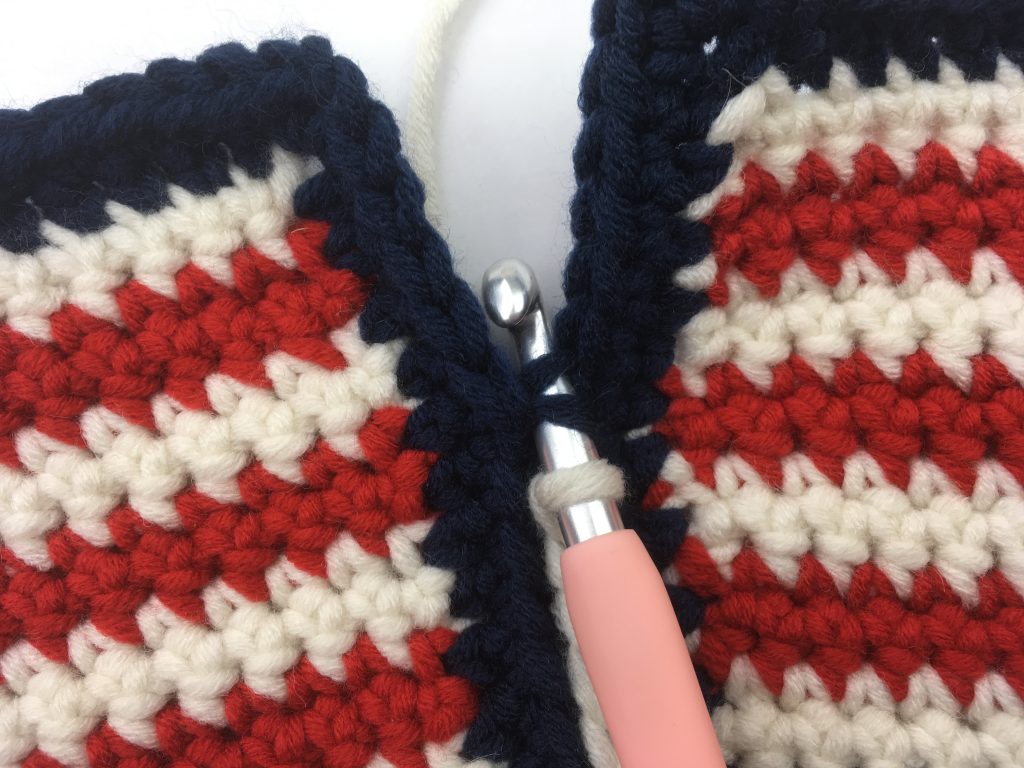
Pull the yarn through the two stitches you picked up to give you two loops on the hook.

Joining instructions 3 - Hearts and Stripes Blanket

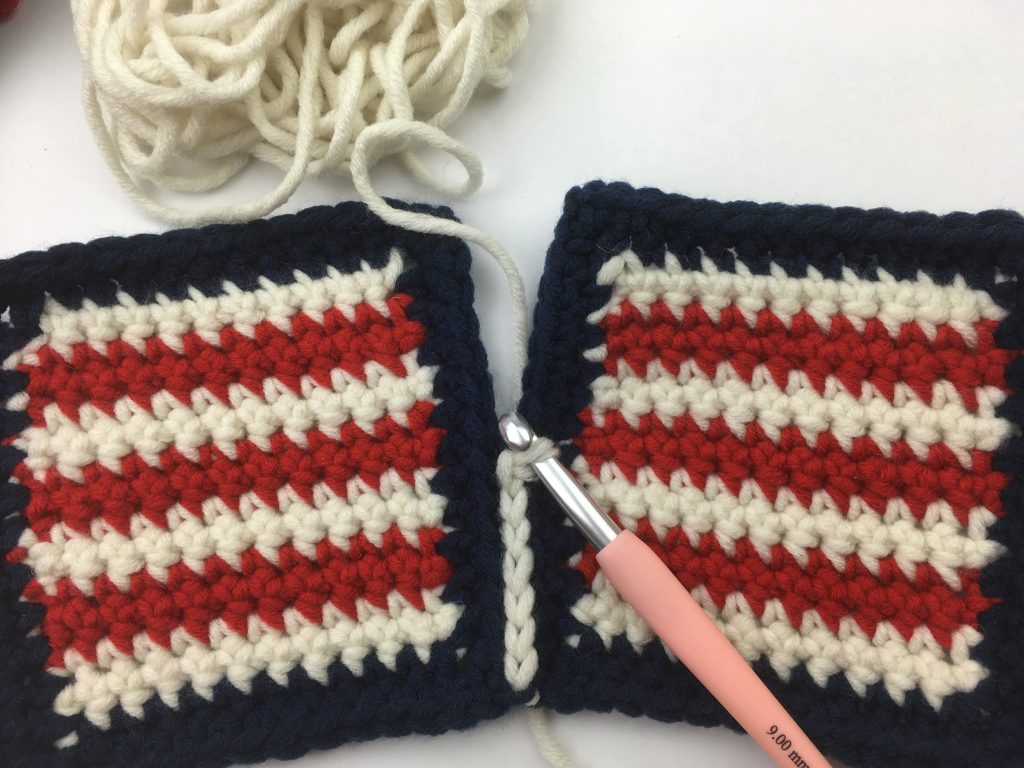
Finally pull the yarn through the loop on the hook to form a slip stitch. From the picture above this means pulling the first loop nearest the end of the hook through the second loop on the hook. The result should look like the picture below.

Design choice – pick a highlight colour for the join and make it a feature. Or use the same colour as the borders of the squares. Using the same colour would make the join less visible.

Hearts and Stripes Blanket – Border

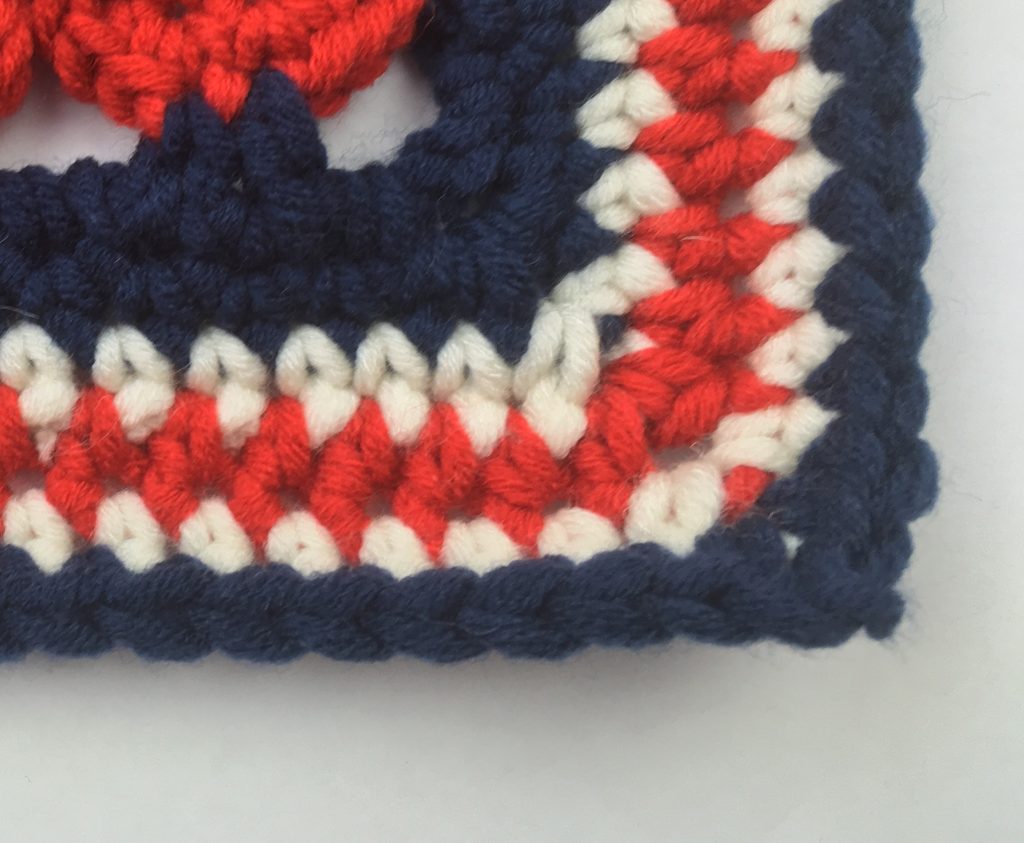
The border for this blanket is very simple and echos the stripes in the squares.

Hearts and Stripes Blanket - border

UK terms

First round – Join in yarn in the colour you used to join the blocks and work one round of DC working 1DC, 2CH, 1DC into each corner. For the design shown here yarn colour white.

Second round – Join in yarn A (red for the design shown here) and work a round of HTR working 1HTR, 2CH, 1HTR into each corner.

Third round – Join in the first yarn again (white) and repeat the first round.

Fourth round – for the final round use the border colour (Navy) and again repeat the first round above.

US terms

First round – Join in yarn in the colour you used to join the blocks and work one round of SC working 1SC, 2CH, 1SC into each corner. For the design shown here yarn colour white.

Second round – Join in yarn A (red for the design shown here) and work a round of HDC working 1HDC, 2CH, 1HDC into each corner.

Third round – Join in the first yarn again (white) and repeat the first round.

Fourth round – for the final round use the border colour (Navy) and again repeat the first round above.

Finish off your ends and there you have it – one Hearts and Stripes Blanket. Hope you like it!

Annie 🙂

Filed Under: Crochet patterns Tagged With: afghan, crochet afghan, crochet blanket, crochet throw, free crochet pattern, Free pattern, heart blanket, hearts and stripes blanket, super chunky yarn, thick crochet throw, uk and us terms

Crochet Blog – update #9

April 19, 2019 by A_Sticky_tape_and_string_girl Leave a Comment

Welcome to my Crochet blog – update #9. It has been such a long time since I posted an update. I have been working on a number of projects but life and the day job took over. It is difficult to find time to get the patterns together and tested. I am trying to ring fence time to work on my crochet projects, for the sake of my mental health if nothing else!

I have been trying to organise this blog better, updating menus and links. Building my Pinterest profile has been a focus and reviewing all the beautiful work that my fellow crochet designers are producing. I have set up a Tailwind tribe to collect and promote inspiring crochet block and crochet blanket patterns.

Join my new Tailwind tribe here!

Project updates

Hearts and Spots blanket

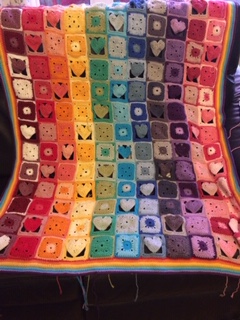
Now onto the projects I have been busy with. Firstly I am close to finishing a couple of long standing projects. My Hearts and Spots blanket which started life as a Christmas present from my husband. The present was one ball of every colour of Drops Paris cotton yarn. The only thing I have left to do is to finish stitching in the ends. There are a lot of ends!! The design is made up of squares that I designed and have already shared as free patterns. I have added the links to these patterns below the picture.

Hears and spots blanket

Open heart square

Sample square

Cosy Knitted blanket

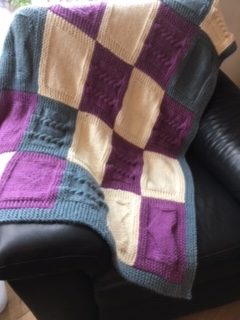
I branched out into knitting for a short time and will be putting the pattern for this lovely cosy blanket up on my blog as soon as I can get it written. Not to make excuses for the delay but I am actually waiting for my husband to draft the chart 🙂

Cosy knitted blanket

Hearts and Stripes blanket

My latest project is a 4th of July inspired Hearts and Stripes blanket. I designed a solid block based on my heart motif and put it with a simple striped square to produce this blanket. The free patterns for the two squares you need to make this project are already posted. I will post the full pattern for the blanket next – just finishing the pattern test! Here is a picture of the finished project. I hope you like it. Below the picture are the links to the patterns for the two squares.

Hearts and stripes blanket

Full Heart crochet block

Striped square

Finally I have been working on yarn recycling. We (Mum and I) put together quite a stash of salvaged yarn and it has been nagging at me from bags in my stash room….. YES… I am so lucky – I have a whole room for my stash. Admittedly the room is only about four foot square so I suppose it is more of a cupboard than a room … but it is stash dedicated space 🙂 Anyway these bags of recycled yarn have been on my mind so you can expect to see an update on that project in the coming days. I think that is it for now – Happy crocheting!

Annie 🙂

Filed Under: craft blog Tagged With: crochet blog, crochet inspiration, free patterns, uk and us crochet terms, uk and us instructions

Free pattern for Striped Block

April 19, 2019 by A_Sticky_tape_and_string_girl Leave a Comment

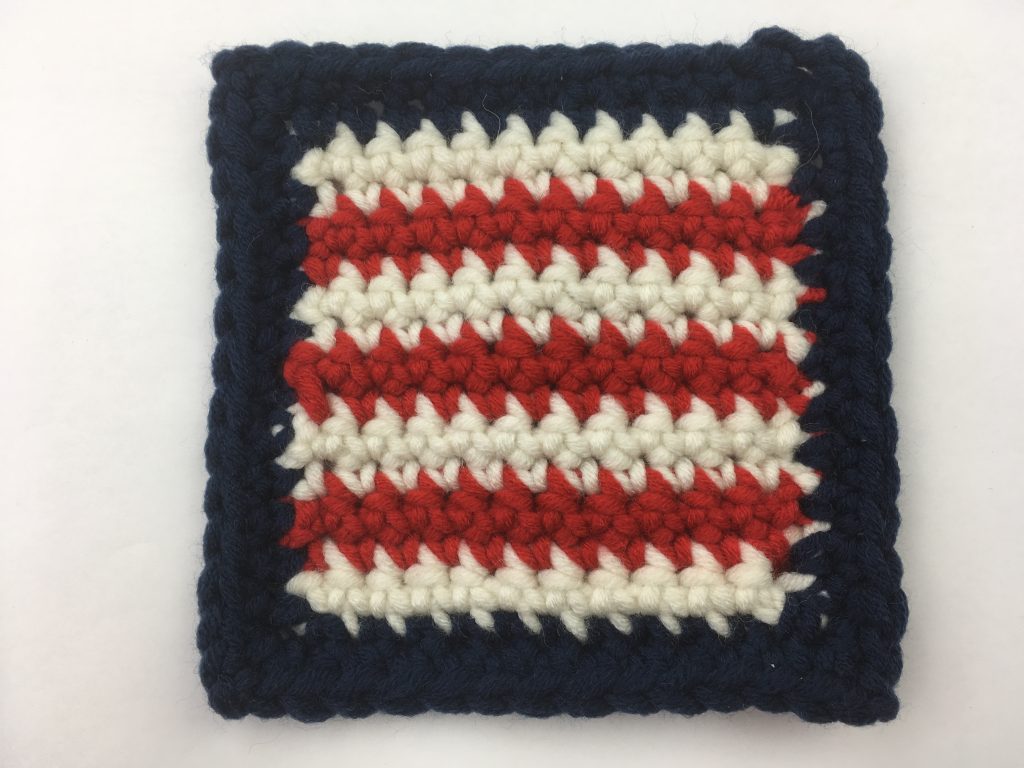
This post includes a free pattern for a striped block which can be used in a variety of blanket designs. The pattern below makes a crochet block of five inches square when worked up in a super chunky yarn on size 9mm needles. To make a larger square simply increase the number of stitches and rows. You can see how I used this block in one of my blanket designs here.

Striped Block - crochet

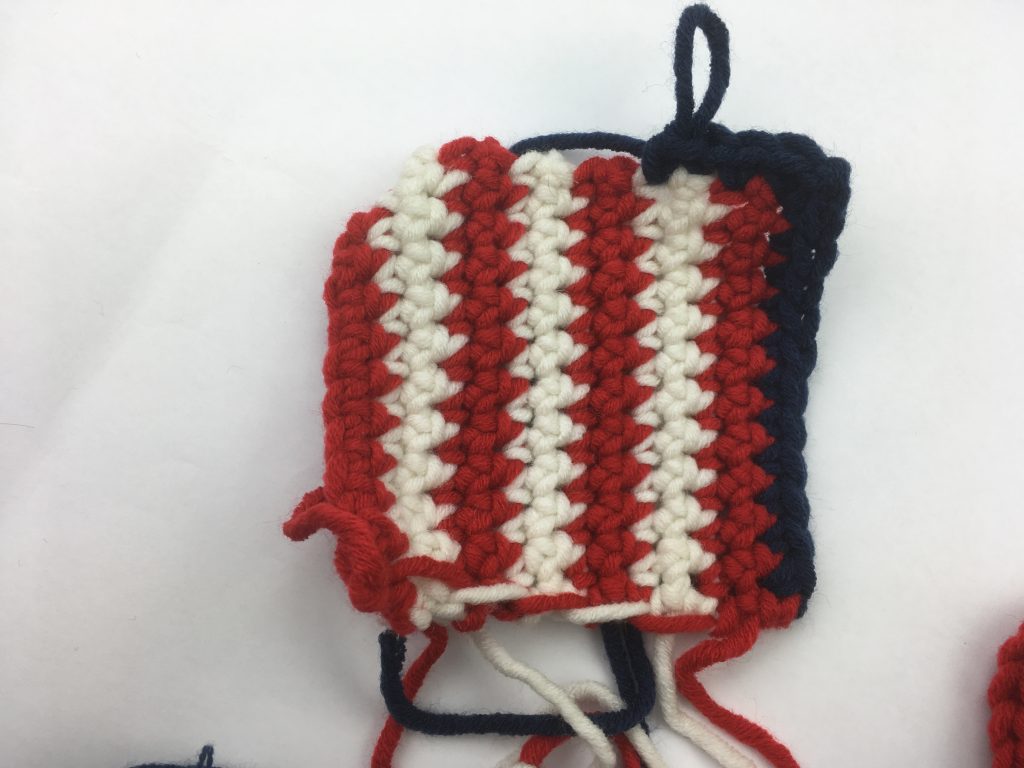
The basic pattern below produces seven stripes of two rows each. If you want your block to have broader stripes work more rows before changing colour. When using just two colours and changing colour every two rows you do not need to cut the yarn. Keeping the twists to a minimum you can work the border over the carried yarn and save yourself from a lot of finishing off! The pictures below show the border being worked in this way.

Edging the Striped Block - crochet

UK terms

With yarn A

First row – Chain 12 then turn.

Second row – working into second chain from the hook, 11DC then turn.

Join in yarn B

Third row – chain 2, DC1, turn.

Fourth row – chain 1, DC11, turn.

Change yarn back to A for the two colour stripe block or change to yarn C if you are using multiple colours.

repeat Third and Fourth row until you have seven stripes.

Border round 1 – Join in the border colour Chain 2, DC11, the last of these 11DCs is in the corner of the square. Chain 2, turn the block so that you are working along the side of the square and work a second DC into the corner. Work another 9DC evenly spaced along the side of the block then one DC into the bottom corner as shown below. Chain 2 then work second DC into the corner. Work a further 9DC across the bottom of the square then into the final corner work 1DC, 2CH, 1DC. Work a further 9DC evenly spaced along the final side of the square and finally work one DC into the corner, 2CH and slip stitch to join to the 2CH at the start point of the round.

Border round 2 – CH2 then DC into each of the stitches working 1DC, 2CH, 1DC into each corner. Complete the round then join with a slip stitch to the 2CH at the start point and finish off.

US terms

With yarn A

First row – Chain 12 then turn.

Second row – working into second chain from the hook, 11SC then turn.

Join in yarn B

Third row – chain 2, SC1, turn.

Fourth row – chain 1, SC11, turn.

Change yarn back to A for the two colour stripe block or change to yarn C if you are using multiple colours.

repeat Third and Fourth row until you have seven stripes.

Border round 1 – Join in the border colour Chain 2, SC11, the last of these 11SCs is in the corner of the square. Chain 2, turn the block so that you are working along the side of the square and work a second SC into the corner. Work another 9SC evenly spaced along the side of the block then one SC into the bottom corner as shown below. Chain 2 then work second SC into the corner. Work a further 9SC across the bottom of the square then into the final corner work 1SC, 2CH, 1SC. Work a further 9SC evenly spaced along the final side of the square and finally work one SC into the corner, 2CH and slip stitch to join to the 2CH at the start point of the round.

Border round 2 – CH2 then SC into each of the stitches working 1SC, 2CH, 1SC into each corner. Complete the round then join with a slip stitch to the 2CH at the start point and finish off.

Hope you enjoy making lots of striped squares and striped blankets. This is a great stash buster square and is a great way to use up odds and ends or salvaged yarn which tends to be in small balls! You can read about my yarn salvage tips here.

Please share pictures of your projects and link back to this page if you reuse my pattern. Happy crocheting!

Annie 🙂

Filed Under: Crochet patterns Tagged With: crochet, crochet block, free crochet pattern, Free pattern, striped block, uk and us terms, uk crochet terms, us crochet terms

Full Heart Crochet Block

April 19, 2019 by A_Sticky_tape_and_string_girl Leave a Comment

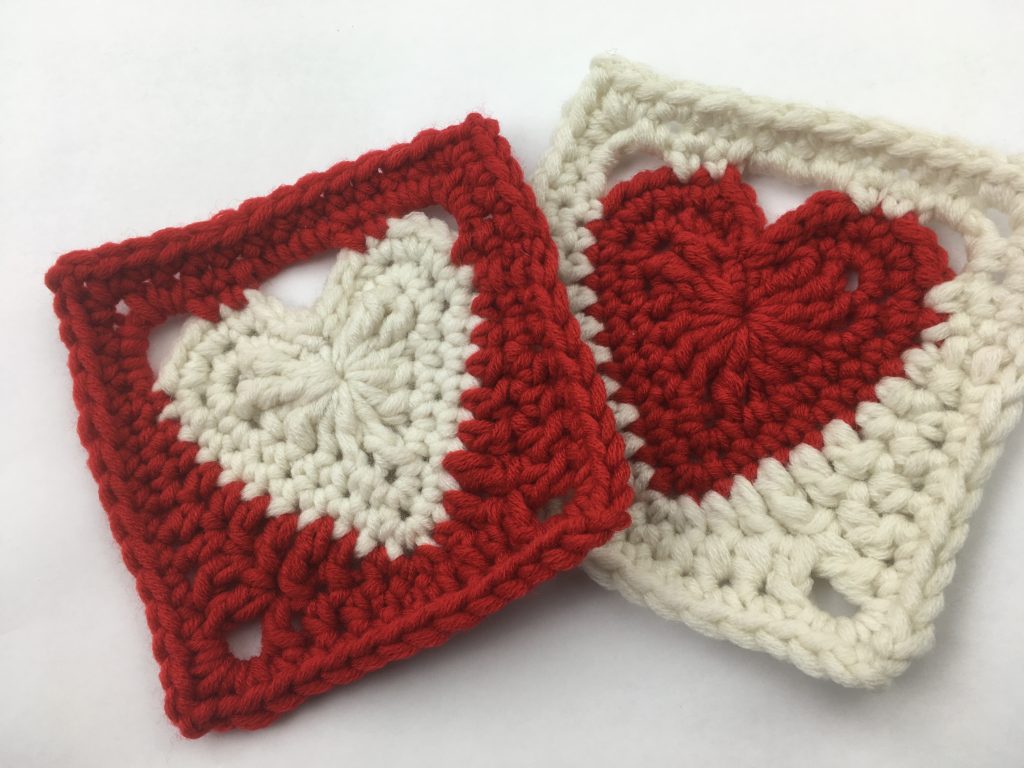
This pattern builds on a heart motif. The basic pattern for my crochet heart can be found here. This pattern uses a slightly adapted version and then puts that heart into the centre of a crochet block. You can use the crochet block to make blankets or cushion covers in any design you like!

The pattern is shown below in both UK and US versions.

Heart Motif

UK terms

First round – Make a magic loop, chain 3. Working into the magic loop, 3 dtr, 3tr, chain 1, 1dtr, chain 1, 3tr, 3dtr, chain 2. Slip stitch into magic loop and pull the thread to close the centre of the heart.

Second round – 2 sl stitch into the gap behind the three chain from the first round.  Work 3dc into the next stitch (top of the left side of the heart). Work 3 dc into the next stitch and 2 dc into the following stitch.   Work 4 dc to take you to the bottom loop of the heart.  Work 3dc into the bottom stitch of the heart then 4 dc up the right side of the heart. Work 2dc, 3dc, 2dc into the next three stitches then 2 sl stitches. Work one final slip stitch into the centre of the heart.

Third round – Work 2 slip stitches then 2dc into the next four stitches. Work 7 dc down the left side of the heart then 3dc into the bottom stitch of the heart. Work 6dc up the right hand side of the heart then 2dc into the next four stitches. Work 2 slip stitches and finish off to complete the heart.

US terms

First round – Make a magic loop then chain 3. Working into the magic loop, 3TRC, 3DC, chain 1, 1TRC, chain 1, 3DC, 3TRC. Chain 2 and slip stitch into magic loop and pull the thread to close the centre of the heart.

Second round – 2 sl stitch into the gap behind the three chain from the first round.  Work 3SC into the next stitch (top of the left side of the heart). Work 3 SC into the next stitch and 2SC into the following stitch.   Work 4SC to take you to the bottom loop of the heart.  Work 3SC into the bottom stitch of the heart then 4SC up the right side of the heart. Work 2SC, 3SC, 2SC into the next three stitches. Work 2 sl stitches and one final slip stitch into the centre of the heart.

Third round – Work 2 slip stitches then 2SC into each of the next four stitches. Work 7 SC, then 3SC into the bottom stitch of the heart. Work 6SC up the right side of the heart then 2SC into each of the next four stitches. Work 2 slip stitches and finish off to complete the heart.

Now you should have a heart motif ready to be placed in the centre of a block.

Putting the Heart into a Crochet Block

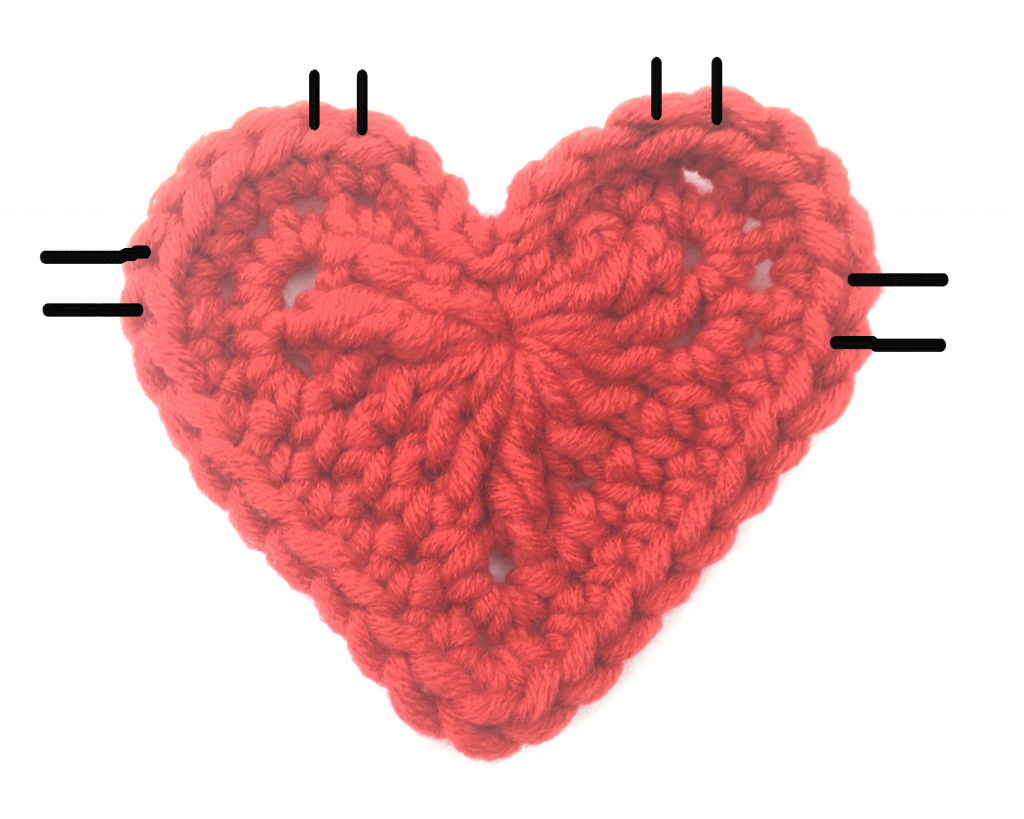
The instructions below start with the heart motif and a second yarn colour. The block is more open at the top to show the heart shape better. This picture shows the ‘touch points’ of the outer square on the heart at the top.

UK Terms

First round – counting the bottom DC as 1, count stitches up the right hand side of the heart. Join yarn in to stitch 10 and work 2CH, 1DC into next stitch then 4CH. Miss the next three stitches and work 2DC into the top of the right hand side of the heart. Work 4CH and 2DC into the top of the let hand side of the heart. Work 4CH. Miss the next three stitches and work 3DC into the left hand side of the heart. Complete the round as follows: 2HTR, 2TR, 1DTR, 1TR, 1HTR. Work 3DC into the stitch at the bottom of the heart, 1HTR, 1TR, 1DTR, 2TR, 2HTR, 1DC and join with a slip stitch to the 2CH at the start of the round.

Second round – CH2, 1DC then working into corner chain 2DC, 2CH, 2DC. Work 2DC into the stitches joined to top of right side of the heart. Work 3 DC into the chain at the top of the heart. Work 2DC into the stitches at the top of the left side of the heart. Working into the corner chain 2DC, 2CH, 2DC. Work down the left side of the heart, 4DC, 2HTR, 1TR. Into the next stitch work 1TR, 2CH, 1TR. Carry on round the bottom of the heart as follows: 2HTR, 3DC, 2HTR. Into the next stitch work 1TR, 2CH, 1TR. Complete the round as follows, 1TR, 2HTR, 2DC. Join with a slip stitch to the 2CH at the start of the round.

Third round – CH2 work DC into each stitch as follows; 3DC to first corner. Work 1DC, 2CH, 1DC into the corner then 11DC across the top of the block. Work 1DC, 2CH, 1DC into the second corner. Work 10 DC down the side of the block then work 2DC, 2CH, 2DC into the bottom corner. Work 9 DC across the bottom of the block. Work 2DC, 2CH, 2DC into the final corner then 6DC up the last side. Join with a slip stitch to the 2CH at the start of the round.

US Terms

First round – counting the bottom SC as 1, count stitches up the right hand side of the heart. Join yarn in to stitch 10 and work 2CH, 1SC into next stitch then 4CH. Miss the next three stitches and work 2SC into the top of the right hand side of the heart. Work 4CH and 2SC into the top of the let hand side of the heart. Work 4CH. Miss the next three stitches and work 3SC into the left hand side of the heart. Complete the round as follows: 2HDC, 2DC, 1TR, 1DC, 1HDC. Work 3SC into the stitch at the bottom of the heart. Work 1HDC, 1DC 1TR, 2DC, 2HDC, 1SC up the right side of the heat. Join with a slip stitch to the 2CH at the start of the round.

Second round – CH2, 1SC then working into corner chain 2SC, 2CH, 2SC. Work SC into the two stitches at the top of right side of the heart. Work 3 SC into the chain at the top of the heart. Work SC into the two stitches at the top of the left side of the heart . Work
2SC, 2CH, 2SC into the corner chain. Work down the left side of the heart, 4SC, 2HDC, 1DC. Into the next stitch work 1DC, 2CH, 1DC. Carry on round the bottom of the heart as follows: 2HDC, 3SC, 2HDC. Into the next stitch work 1DC, 2CH, 1DC. Complete the round as follows, 1DC, 2HDC, 2SC. Join with a slip stitch to the 2CH at the start of the round.

Third round – CH2 work SC into each stitch as follows; 3SC to first corner Work 1SC, 2CH, 1SC into the corner. Work 11SC across the top of the block and 1SC, 2CH, 1SC into the second corner. Work 10 SC down the side of the block then work 2SC, 2CH, 2SC into the bottom corner. Work 9 SC across the bottom of the block. Work 2SC, 2CH, 2SC into the final corner then 6SC up the last side. Join with a slip stitch to the 2CH at the start of the round.

And there you have the Full Heart Block. I hope you like it! You are welcome to use it free of charge but not to resell the pattern without explicit permission. Please share photos of any projects you make using this design. If you post anything online please share a link back to this page.

Happy crocheting!

Annie 🙂

Filed Under: Crochet patterns Tagged With: crochet block, crochet heart square, crochet square, free crochet pattern, Free pattern, heart, heart square, uk and us crochet terms, uk and us instructions

Blogging is NOT EASY!!!!

March 10, 2019 by A_Sticky_tape_and_string_girl Leave a Comment

How many pins and blog posts have you seen that tell you how EASY it is to start a blog? These posts make it sound so quick and so simple that everyone should be doing it, but is it really that easy? There are lots of bloggers who only blog about blogging and they all claim to be sharing their ‘secrets’.   Some will ask you to sign up for courses or pay for resources that turn you into an overnight blogging success.  In my view there really is no need to spend any money until you have started on your blogging journey and have done all the things that you can do without paying out!

The bloggers telling you how easy it is, are making good money by selling the dream of an easier lifestyle. A lifestyle where you have passive income and you don’t have to leave your house. They give the impression that blogging is all about creativity.   For the vast majority this will only ever be just a dream.   Like anything blogging requires hard work and quite a lot of skill and knowledge!  The dream sounds less attractive when described honestly but it is till a dream!!

Find out whether blogging is really for you!

Following the advice so many bloggers push out can get you to the point where you have paid out for services to support your blog but have no blog because (sorry I am going to say it again!) Blogging really isn’t easy!

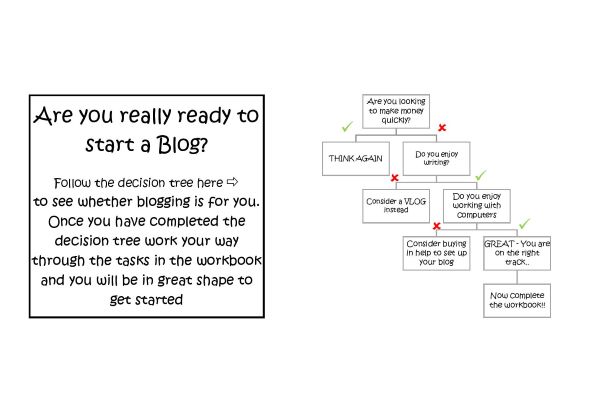
There is some good news though.  If you are really serious about starting a blog, there is so  much you can do to validate your ideas before spending any money at all.   This is the tough love bit here – are you really serious about starting a blog and why do you want to do it?  I produced a short decision tree and workbook to help you decide whether blogging is for you and whether you are ready to spend money and launch your blog…..  you can see the decision tree in the picture below and download the workbook as a free printable below.

Is blogging for you – Letter (17062 downloads ) Is blogging for you – A4 (16643 downloads )

Learn from my mistakes!

My own blog journey started a few years ago when I first began reading all the pins on Pinterest talking about how easy it was to start a blog and make a fortune. Despite loving my day job I was interested in starting a blog as a hobby that could eventually provide an income stream.   I have also always harboured dreams of being a writer ?

After spending a year or so with ‘start a blog’ on my do list I had made NO PROGRESS other than to collect pins and read more blogs on how EASY it was. 

Finally getting started……

After about a year I bought myself a domain name and entered into a hosting contract. One of the things I did learn was that getting a domain is the safest route to protecting your work. I didn’t even look at pure blogging solutions like blogger or blogspot.   These might have been an easier route to get started.   The reasons I went for my own domain were:

  • I wanted to be in charge of my own destiny and not be bound by rules set down by the platform – rules that are subject to change.   I own my own website and control everything about the content myself
  • I wanted to be able to ‘monetise’ my blog.  I will put up a separate post on how this is not easy either but for now suffice to say that this means I wanted to be able to generate an income from my blog.

Besides all that, it is so much fun thinking of names for your site and the deals the hosting companies offer seem such bargains. I bought my domain and started paying for hosting waaaay too early in the process. There was a lot I could have done before investing.

Hosting – only pay for what you need

Pretty much all the blogs I read seemed to recommend Blue Host. However, after doing my own research at the time, I went with 1&1 IONOS and they have been great.  It is always worth checking out a number of hosting providers and picking the best deal for you.  It is also worth checking for reviews of the services provided as quality of service can change over time.

When you start to set your own blog up, whoever you choose to host your blog, check out their offers and plans. You probably only need to go for the basic level and watch out for lock in type deals. If you find blogging is not for you then you will want to be able to end the commitment.

A lot of the ‘advice’ and ‘secrets’ shared by bloggers suggest hosting plans that have a two-year lock in.  This means that low price you are quoted will need to be paid montly for 24 months or more before you can end the contract.   Not such a low commitment after all!    There is also sometimes a statement on the ‘start a blog’ blogs to the effect that special pricing for hosting is only available through links from someone’s blog. In my experience that has not been true. If you go straight to the hosting company via google the same pricing is often available.

Affiliate Links

Links from blogs do two things…. firstly, for you they are an easy way to find the businesses that can help you set up.  Secondly, they can provide payment to the blogger who publishes the link. These payments are called affiliate payments and range in value from zero through a few pennies but can also be very lucrative for the blogger if someone (like you) follows a link and then makes a purchase. It doesn’t cost you anything more and bloggers usually recommend services that they value themselves.

I am an affiliate for a number of products and businesses but so far (just over two years in) have not had any affiliate income. That said, I have not pushed that side of my blog. My motivation in publishing this blog post is to ‘tell it like it is’ warts and all. I would be delighted to generate some affiliate income but only from people buying products and services they really need, with their eyes open!

WordPress – the best and the worst

Anyway, climbing down from my soap box……So far, so easy but …. so far no blog! The next stage was to upgrade my hosting contract to include WordPress. Again, an easy step and then to download and set up my blog using WordPress. Downloading WordPress is very easy. Setting up my blog using WordPress – not so easy!! WordPress is an amazing tool but NOT EASY!  

In fact this is the point at which it became really hard!! Everyone skips over this bit in their instructions on blog set up but the set-up is NOT straight forward. There are default settings you need to change. Everything is written using terms that make no sense unless you have A LOT of knowledge.   

Getting to grips with WordPress! 

I finally cracked this stage of the process when I found some genuinely free resources. The link below will take you to a vlog about setting up WordPress blogs and I cannot recommend these tutorials highly enough. I hope they continue to be available – at the time of writing they are still there! I found them with a simple but quite specific google search. Here is a link http://imarkinteractive.teachable.com/p/understanding-wordpress

You need to set aside a reasonable amount of time (I am talking a few days) for this education and set up. I also found I needed two screens on the go so that I could work on WordPress on my laptop and watch the tutorial at the same time on an iPad. There is A LOT to learn and to be honest I skimmed a bit and now regret that. I would like to be better at the ‘nuts and bolts’ than I am. Time spent learning would definitely have paid back in saved time later.  

Don’t Expect this to be quick!!

As you work your way through the technical set up you have to make all sorts of decisions on appearance and layout. It becomes a strange mix of technical and creative. I think the guy behind the tutorials also offers a service to create your blog for you and those services are readily available elsewhere. If you are purely creative rather than technical and have the money to spend then paying for set up might be an option you want to consider. I think pricing can be ‘reasonable’ but still not something I could have afforded to do!  

Sticking with the tutorials and technical learning I managed to get through and once you are through this set up stage you do actually have a blog!! Woo hoo!!! Now…. what are you going to say/write?    

I remember getting to this stage and wishing that I had spent time creating more content before getting bogged down with the technical side and starting to pay for hosting! Here is my suggested list in the order I wish I had worked when I started.   Some of these overlap with the free workbook above that will help you decide whether blogging is for you.

8 tips to get you into great shape for blogging BEFORE you spend any money!

  • Decide on the subject you want to blog about.   Wisdom out there says pick a niche and stick to it.   I haven’t been able to do that very well – which could be one of the reasons for my lack of success!   I blog about around at least three different themes – crochet, planners and blogging.  I am not (nor do I claim to be) an expert in any of these.
  • Research other blogs in the areas you have selected.  
  • Make lots of google searches in the areas you have picked and note which blogs come up in the searches – these are your competition. 
  • Work out which key words in google searches return these blogs as the search results.   See if you can find searches in your subject areas that do not return many blogs or other resources.  You will need this list of key words later!

All this and no money invested yet!!…..

  • Next….decide on a name and branding – themes, colours, picture styles.   Write down what your fonts and colour schemes will be
  • Write some content – this could be in Word, in an email, in a notebook at this stage but write as much content as you can.   This will show you whether you are capable of writing consistently in your chosen area.   The more innovative and newer the material you write, the more likely you are to attract visitors to your blog.   The process of typing this into your blog is only a tiny part of the effort required to run a blog.  Coming up with new material on a regular basis is a big and important part and a big factor in determining your success or failure.   As a start point, having four or five quality blog posts ready to go would be a good start.
  • Take photos or use an app like Canva to generate images in the formats used by social media platforms like Facebook and Pinterest.  You will need these to market your blog.
  • Develop a following on the big social media platforms.   Pinterest is amazing for this, Instagram and facebook can also be useful.   I believe Twitter is good but I don’t use that much  at this stage myself so I cannot really comment.   More on this in a later post.

Once you have completed these steps I would say you are in a good place to set up your blog and at that point it would be worth spending on a domain name and hosting.

Still want to be a blogger!!?

As I said at the top of this post Blogging is hard!!!   It is possible though. Along my blogging journey I have found some excellent resources and some genuinely helpful blogs and amazing people.  That said, I am writing this in March 2019 and currently have average page views of around 1,500 and average income of £1.30 per month! Needless to say my outgoings are FAR higher. I am not sure this will ever deliver me an income but I am going to keep going.   

The main reason I am keeping going is that I can see it build. Very slowly but it does build… you can read some of my blog progress updates here. I put out a few updates then life took over and I had a little break. When I came back after three months I found that I was still getting a building number of page views.   This was a major lesson for me. As I said above having content that people want to read is really important!

Ok Blogging is NOT easy but it is SUPER rewarding

Another reason I will keep going is job satisfaction.    I get incredibly excited when I see that people are visiting my blog.   I am completely thrilled when I get a comment from a real person who has read my blog and wants to make contact.    I use Google Adsense to try to monetise my blog and the days when I earn £0.01 are great days.   Days when someone clicks on an advert and I earn a few pence are AMAZING days.  

As I said above I work as an affiliate for a number of businesses that I have used and value highly.  I didn’t include the links above but will include them here so legally I have to include the following text.  Some of the links in this post are affiliate links and if you follow them could generate a small payment to me at no additional cost to yourself.  

Useful tools and apps to help you build your blog

1&1 – for hosting and domain name registration.   Follow the domain name registration link which will take you to a screen where you can test (at no cost) any domain name you can think of and see whether it is available.   Once you have a name you like you can purchase that domain name and leave it there or you can purchase a hosting package with WordPress if you are ready to take that step.

Canva – great for creating images for your blog and for social media.   More on this in a later post but I couldn’t work without Canva.   At the time of writing, they offer a reduced package for free which is as far as I have gone and  also  a free trial of their full application.   My art work lets me down I think so this is maybe something I should be spending more time on but there is so much I can still do without spending so it won’t happen any time soon!

Tailwind – invaluable for promoting your blog.   Again, more on this in a later post.  

long term investment of time pays off

I don’t get very much time to work on my blog.    I get about five hours during the week whilst I am commuting to work and generally get four or five hours at the weekend to focus on new content.   Progress is slow but I have a long long list of things I could be doing or doing better.    I can see that blogging could be a full time job.   Once again the bloggers who tell you that this is easy or that you can make your fortune and imply that you can do this with very little effort, are seriously misleading.    I would not want to put anyone off – if you would like to become a blogger – go for it!!!!  

Here are my final do’s and don’ts

DO NOT

  • overspend on set up (unless you have done everything you can AND can afford to invest).  
  • depend on this to make your fortune unless you make it a full-time job and give it all your focus. 
  • expect it to be easy!!!!    

BUT….. DO

  • connect with like-minded people.  
  • learn from other people’s mistakes and triumphs (do lots of research).  
  • put out good content
  • focus on social media as the means to market your blog.

I am planning two more posts on this theme.   Marketing your blog is not easy and Monetising your blog is not easy…..    till then…..

Happy blogging!

Annie 🙂

Filed Under: Blogging Tagged With: advice for new bloggers, blog, blogging, decision tree, free workbook, new blogger, new to blogging, set up a blog

  • « Go to Previous Page
  • Page 1
  • Interim pages omitted …
  • Page 4
  • Page 5
  • Page 6
  • Page 7
  • Page 8
  • Interim pages omitted …
  • Page 14
  • Go to Next Page »

Footer

Newsletter

Copyright © 2026 · Genesis Sample on Genesis Framework · WordPress · Log in