• Skip to primary navigation
  • Skip to main content
  • Skip to footer

Stickytapeandstring

Created with WordPress managed by 1&1

  • Craft projects
    • craft business tips
    • craft blog
    • Crochet patterns
    • Upcycling
    • craft with kids
  • Blogging
    • New to blogging
    • Blog diary
  • Bullet Journal
  • About me
  • Welcome!!

Craft projects

Daisy block

July 21, 2018 by A_Sticky_tape_and_string_girl Leave a Comment

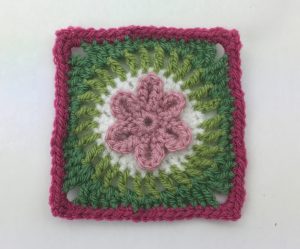
Here is the pattern for my latest block design.   I have worked up a few examples, playing with colours and yarn types.   I plan to add a row of these to my spring flowers blanket.   This is the block worked up in those colours using Stylecraft DK yarn and a 4mm hook.
I love playing with an ombré effect.   Here is the block using shades of pink radiating from a white centre.   The white can only be seen from the back!   The yarn here is Drops Paris worked on a 5mm hook.
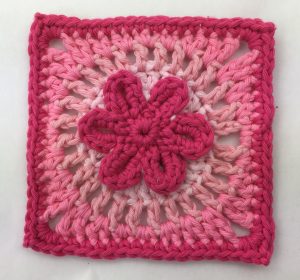
Here are a couple of the blocks in Drops Muskat, back on a 4mm hook.  One has a coloured flower against a white background.   I really like the sheen on this yarn.   I will put a proper review into my next blog update.   I think a baby blanket with coloured flowers against white would be sweet.   The photo also shows the reverse with white flowers on blue.   You can see I became quite attached to this design quite quickly!
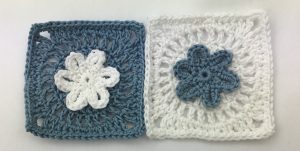
Here is the pattern 

Daisy block – UK terms

Foundation round 1 – Make a magic loop, chain 2, 11 DC into the loop, pull closed and join with a slip stitch

Round 2 – (chain 6, slip stitch into the root of the chain to form a loop, slip stitch into the next 2 stitches) x 5, chain 6, slip stitch into the root of the chain to form a loop, slip stitch into the base of the first chain loop. You should have a circle with six loops.

Round 3 – (7 DC into the first six chain loop, slip stitch into the stitch between loops) x 6, slip stitch to join to start point. You should have six petals.

Round 4 – (chain three, slip stitch into the stitch between the petals) x 6, slip stitch to join to the start point. Tip – These chains need to sit behind the petals but will probably be in front as you work them. Don’t worry, you can pull the petals back through at the end of the round.

Round 5 – (work 3 DC into the three chain loop, 1CH) x 6, slip stitch to join to start point.

Round 6 – chain 3, 2 Tr, (2Tr into the chain space, 3 Tr) x 2, 1Tr into the chain space, (3Tr, 2Tr into the chain space) x 2, 3Tr, 1Tr into the chain space. Join with a slip stitch to the top of the starting 3 chains.

Round 7 – chain 4, (Tr, chain 1) x 27, join with a slip stitch to the third chain in the 4 chains that started the round.

Round 8 – this is where we square the circle! Ch2, DC into the first chain space. Complete the round by working two stitches into each chain space as follows: (DC HTr, HTr Tr, Tr DTr, 2 chain, DTr Tr, Tr HTr, HTr DC, 2DC) x 3, DC HTr, HTr Tr, Tr DTr, 2 chain, DTr Tr, Tr HTr, HTr DC, slip stitch to join to the top of the two chains the started the round.

Round 9 – 2ch, work DC into each stitch. At the corners work 2DC, 2ch, 2DC into the two chain space. At the end of the round join with a slip stitch to the top of the two chains the started the round. And you are done! Sit back and admire or plan the project you are going to make with this lovely little block!

Daisy block – US terms

Foundation round 1 – Make a magic loop, chain 2, 11 SC into the loop, pull closed and join with a slip stitch

Round 2 – (chain 6, slip stitch into the root of the chain to form a loop, slip stitch into the next 2 stitches) x 5, chain 6, slip stitch into the root of the chain to form a loop, slip stitch into the base of the first chain loop. You should have a circle with six loops.

Round 3 – (7 SC into the first six chain loop, slip stitch into the stitch between loops) x 6, slip stitch to join to start point. You should have six petals.

Round 4 – (chain three, slip stitch into the stitch between the petals) x 6, slip stitch to join to the start point. Tip – These chains need to sit behind the petals but will probably be in front as you work them. Don’t worry, you can pull the petals back through at the end of the round.

Round 5 – (work 3 SC into the three chain loop, 1CH) x 6, slip stitch to join to start point.

Round 6 – chain 3, 2 DC (2DC into the chain space, 3 DC) x 2, 1DC into the chain space, (3DC, 2DC into the chain space) x 2, 3DC, 1DC into the chain space. Join with a slip stitch to the top of the starting 3 chains.

Round 7 – chain 4, (DC, chain 1) x 27, join with a slip stitch to the third chain in the 4 chains that started the round.

Round 8 – this is where we square the circle! Ch2, SC into the first chain space. Complete the round by working two stitches into each chain space as follows: (SC HDC, HDC DC, DC TR, 2 chain, TR DC, DC HDC, HDC SC, 2SC) x 3, SC HDC, HDC DC, DC TR, 2 chain, TR DC, DC HDC, HDC SC, slip stitch to join to the top of the two chains the started the round.

Round 9 – 2ch, work SC into each stitch. At the corners work 2SC, 2ch, 2SC into the two chain space. At the end of the round join with a slip stitch to the top of the two chains the started the round. And you are done!

I hope you enjoy this pattern as much as I enjoyed creating it.   Happy crocheting!

Annie 🙂

Filed Under: Craft projects, Crochet patterns Tagged With: crochet block, flower block, Free pattern, ombre, uk and us instructions, yarn

Crochet blog – update #7

July 16, 2018 by A_Sticky_tape_and_string_girl Leave a Comment

Hello and welcome to my 7th update.    I am still aiming to do these weekly but my week was crazy busy last week and I didn’t make enough progress to tell you about!

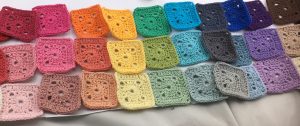
Over the last two weeks I managed to complete the squares for my hearts and spots blanket.  Here are the last four rows.    These are not laid out in the order I plan to put them together here but you get the idea.

The original colour layout looked like this.    I will be joining the blocks in this order more or less.

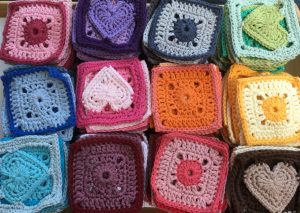
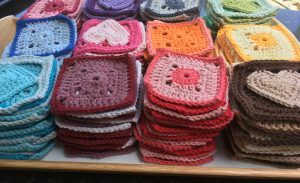
The heart squares are less stable than the spot and solid squares so rather than make it random I am rotating the three designs which means that a heart square will always be surrounded by solid/spot squares.  Here are the finished blocks in their colour piles!

I have been working on joining methods.    For my sunshine flower blanket I wanted to make the joins as invisible as possible.    This hearts and spots blanket will make a feature of the joins.    I am using the mid colour from each of the sets to join the blocks in each row.    For the joins between rows I haven’t decided what to use yet.    I might carry on with the mid colour of the previous row or might use the bold colours.

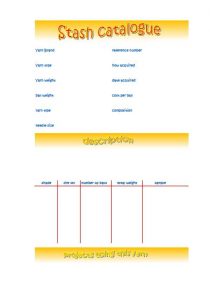
Away from this blanket I have been trying to get organised.    I recently published a couple of posts on daily and weekly planning with free printable planner downloads.  I have also been working on a stash catalogue which I will share in a separate post but this is what it looks like.   Here is the file as a free download.   The file is A5 size so you might need to resize it if you would like a different format.    If you have any problems with this please let me know and I will resize the file for you!   stash catalogue (19536 downloads )

I have quite a large stash of yarn (!) and much as I try to make use of it before buying more yarn, it doesn’t seem to reduce any!   I hope that having it catalogued and available to browse through will improve my ability to create ideas to use it all.   One thing I have found is that as I go through the backs of cupboards and packing boxes to look at all my yarn, I am falling in love with it all over again.    I have found some yarns I didn’t know I had!    I read an article on yarn stashing and I know I am not the worst for this.   I do not have any yarn deliberately hidden from my family.    I loved one story I read, of a knitter who had removed a bath panel to create a new hiding place for an extreme stash 🙂

That’s all from me this week.   I will go back to joining squares and cataloguing my stash.    I hope to be able to edge the hearts and spots blanket next weekend and to share the final pattern.   Happy crocheting!

Annie 🙂

Filed Under: craft blog, Craft projects Tagged With: blanket, blog, Craft, crochet, design, productivity, stash, stash catalogue, yarn

Crochet blog – update #6

July 1, 2018 by A_Sticky_tape_and_string_girl Leave a Comment

Hello and welcome to my sixth update!   This week I made more progress on my blanket project.   I realised I have been calling it different names as is has progressed.   It started life as my Shades of the Rainbow blanket but more recently I have been calling it Hearts and Spots!   Whatever name it ends up with I have to confess, I am ready to move on… I have never been great at finishing things but this blog acts as a conscience so I will get it done!

This photo shows four more completed rows of squares.   Only four more to go and I can start the making up.   I have already made the majority of the blocks for those last four rows but still need to fasten off the ends.

I started to look into pricing of this project, researching on Etsy and google for similar items and found a huge range of pricing.   Some of it was incredibly low and looks to cover the cost of materials at best.   This got me thinking!   I built myself a little spreadsheet to calculate the cost of producing the blanket.   I know what the yarn cost including shipping and I used the UK minimum wage to value my time. The blanket isn’t finished yet but when it is I will know what I should be charging. The spreadsheet has a section to record the number of hours worked.   I think I will use one for every project from now on.   I created it as a PDF and set up a FREE DOWNLOAD HERE.   Pricing basics (25898 downloads )   I wrote a longer post on pricing which you can read here – pricing basics.

As a break from my big project this week I designed this new block in the picture above.   I have made it up in a few colours with some of my left over scraps. I am very pleased with the way it turned out.   Here is a link to the FREE PATTERN. There are no complicated stitches so it should be suitable for beginners.   I have listed the instructions in both UK and US notation.   I haven’t decided on my next big project but I would quite like to make a blanket with this block.   I worked it in Drops Paris yarn on a 5mm hook and the finished blocks are about 14cms square.

The problem with these little side projects is that they hold up work on the main project.   I do tend to get a bit distracted by new things.   Confession time, I have three other side projects on the go.   I am working on a cushion design, a summer top and a shoulder bag design.   The good news is that I will be able to share those patterns with you soon I hope.

For now it is back to finishing of little Hearts and Spots squares.   I hope you have a good week. Happy crocheting!

Annie 🙂

Filed Under: craft blog, Craft projects Tagged With: blankets, blocks, commuter crochet, cotton, Craft, crochet, design, Free pattern, handmade, squares, stash, stash busting

Wagon Wheel Block

July 1, 2018 by A_Sticky_tape_and_string_girl Leave a Comment

Hello!   This post contains a Free Pattern for my Wagon Wheel Block.   I wanted to create a block that would lend itself to Ombre projects and would also be suitable for stash busting as I have a lot of small remnants of yarn left over from my larger crochet blanket projects.

The pattern is made of simple stitches so should be suitable for beginners.    I made this up in Drops Paris which is 100% cotton in aran weight and works up on a 5mm hook.

Wagon Wheel Block – UK terms

Round 1.    Chain five and join to make a circle.

Round 2.    Chain 2, work 12 DC into the circle and join with a slip stitch to the second chain that started the round.

Round 3.     Chain 4,  (Tr, chain 1) repeat 11 times so that you have thirteen spokes to the wheel – (the chain that started the round plus 12 more spokes).   Slip stitch into the third chain of the 4 chains that started the round.

Round 4.     chain 2, DC into the space between the trebles on the previous round.   (2 DC into the space between trebles) repeat 11 times.   So you have two DC between each of the trebles on the previous row.   Join with a slip stitch to the second of the chains that started the round.

Round 5.     Chain 4, (Tr, chain 1) repeat 24 times so that you have 26 spokes to the wheel – (the chain that started the round plus 25 more spokes).   Slip stitch into the third chain of the 4 chains that started the round.

Round 6.     Chain 2, DC into the space between the trebles on the previous round.   (2 DC into the space between trebles) repeat 24 times.   So you have two DC between each of the trebles on the previous row.   Join with a slip stitch to the second of the chains that started the round.

Round 7.    Chain 2, (2DC into same stitch, Htr, 2 Tr into same stitch, DTr,  chain 5, miss three stitches and DTr into fourth stitch, 2Tr into same stitch, Htr, 2 DC into same stitch, DC, DC)  repeat twice, 2DC into same stitch, Htr, 2 Tr into same stitch, DTr,  chain 5, miss three stitches and DTr into fourth stitch, 2Tr into same stitch, Htr, 2 DC into same stitch, DC.  join with a slip stitch to the second of the chains that started the round.

Round 8.   Chain 2, DC into each stitch from the row below to the corner 5 chains.   Work into each corner 3 DC, 2 chain, 3 DC.  Repeat to end of round and join with a slip stitch to the second of the chains that started the round.

Round 9.     Chain 2, DC into each stitch from the row below.   At each corner work 2DC, chain 2, 2DC into the 2 chain space on the row below.    At end of round join with a slip stitch to the second of the chains that started the round.

NOTE – where you are changing colour on each round to create the ombre effect it works well if you move the start of each colour around rather than start and stop in the same place each time.

Wagon Wheel Block – US terms

Round 1.    Chain five and join to make a circle.

Round 2.    Chain 2, work 12 SC into the circle and join with a slip stitch to the second chain that started the round.

Round 3.     Chain 4,  (DC, chain 1) repeat 11 times so that you have thirteen spokes to the wheel – (the chain that started the round plus 12 more spokes).   Slip stitch into the third chain of the 4 chains that started the round.

Round 4.     chain 2, SC into the space between the trebles on the previous round.   (2 SC into the space between trebles) repeat 11 times.   So you have two SC between each of the trebles on the previous row.   Join with a slip stitch to the second of the chains that started the round.

Round 5.     Chain 4, (DC, chain 1) repeat 24 times so that you have 26 spokes to the wheel – (the chain that started the round plus 25 more spokes).   Slip stitch into the third chain of the 4 chains that started the round.

Round 6.     Chain 2, SC into the space between the trebles on the previous round.   (2 SC into the space between trebles) repeat 24 times.   So you have two SC between each of the trebles on the previous row.   Join with a slip stitch to the second of the chains that started the round.

Round 7.    Chain 2, (2SC into same stitch, HDC, 2 DC into same stitch, TRC,  chain 5, miss three stitches and TRC into fourth stitch, 2DC into same stitch, HDC, 2 SC into same stitch, SC, SC)  repeat twice, 2SC into same stitch, HDC, 2 DC into same stitch, TRC,  chain 5, miss three stitches and TRC into fourth stitch, 2DC into same stitch, HDC, 2 SC into same stitch, SC.  join with a slip stitch to the second of the chains that started the round.

Round 8.   Chain 2, SC into each stitch from the row below to the corner 5 chains.   Work into each corner 3 SC, 2 chain, 3 SC.  Repeat to end of round and join with a slip stitch to the second of the chains that started the round.

Round 9.     Chain 2, SC into each stitch from the row below.   At each corner work 2SC, chain 2, 2SC into the 2 chain space on the row below.    At end of round join with a slip stitch to the second of the chains that started the round

And there it is.   I hope you like it as much as I do.   Happy Crocheting!

Annie 🙂

Filed Under: Craft projects, Crochet patterns Tagged With: blocks, commuter crochet, crochet, design, Free pattern, handmade, stash busting

pricing basics

June 30, 2018 by A_Sticky_tape_and_string_girl 2 Comments

Firstly if you are reading this CONGRATULATIONS on finishing your handmade project. Finishing projects is not my particular strength but I am super good at starting them ?

I love to browse the beautiful projects on Etsy and Ravelry and I believe that all the lovely creative people who make them deserve to be rewarded appropriately for the joy and beauty their work delivers. However, when I checked out the pricing of these amazing handmade products it appears to me that it is often grossly undervalued by the creator!

My current passion is crocheted blankets. Looking on Etsy I found that pricing in that category has a huge range. Some blankets are priced at £1,000 + and are commission only or designer one-offs made with expensive yarn. However, some are priced at a level that looks to barely cover the cost of the materials.

There are several different ways to value your work for sale and the best method for you really depends on your overall goal.


The basic approach. If you were producing goods for sale in a commercial world you would work out the full cost of your raw materials, add in the cost of your time and any overheads and apply a profit margin to get your price excluding shipping cost. From a review of handmade goods for sale on Etsy, I can see some examples of this type of pricing but in many cases the prices being charged look too low for this to have been the calculation used.

This means at first impression, either craft workers are selling their work at a loss or grossly undervaluing their time. It could be that they are selling individual projects at a loss but overall their business is making a healthy profit… interesting?

There are many possible reasons you are looking to sell your work but most of us are looking to make money one way or another!

If making money is your primary objective, is the income from selling your finished products where you will make that money?   This might sound like a strange question but…. bear with me….

Let’s assume you spend hours producing a beautiful crocheted blanket. The cost of yarn alone is likely to be at least £25 and could be far more than £100 for premium yarns. Add in the time to make the item… again this will be a huge range of values let’s assume 90 hours which would mean two hours a day for a month and a half. In the UK we have a national minimum wage which pays adults between six and eight GBP per hour so to simplify let’s go for the middle of the range and say £7 per hour. This means the labour cost of your project is 7 multiplied by 90 i.e. £630.

I am not sure whether you would expect to earn the minimum wage for your talented creative time but that is the minimum value that the outside world would place on your time in employment in the U.K.

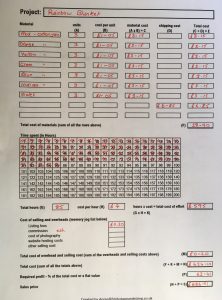
Keeping things simple, you can see that the cost of producing the blanket is £630 for your time plus at least £25 for the materials giving COST £655. This means that you have to charge at least this much to avoid making a loss. The value you calculate for your time is the same as a wage or salary compensating you for your time. Anything you sell the item for on top of this cost is the profit you make.  I have put together a worksheet to help you with pricing your project.   Here is the free download.    I hope you find it helpful.   Pricing basics (25898 downloads ) .    This is what it looks like completed for a project.

I have not completed the commission cost as this is a function of the price on some selling sites.  You do need to consider this cost when working out how much you are earning.   I do not include shipping costs to your customers as these are normally on top of the sales price.

If craft projects are not your source of income and you ‘donate’ your time for the love of the craft then all you have to consider is your cost of yarn and any overheads. Anything above that would be ‘profit’.   However, do consider, your time is a limited resource.   You can only produce so many items.   You would need to view this as a way of funding your hobby rather than anything you can build a business on.

There are other ways to make money from your work.   In the example above, you have spent let’s say 180 hours to create a single product.   If you want to make a living, you have to cover the cost of those 180 hours with the sale of that one product. What if you had two products at the end of the project? You would spread the cost of that time over those two products!   The main source of your income is the primary product but you can make secondary products from the same effort.

    1. If your project was designed by you, the best secondary product from your work would be the pattern or instructions to produce the work. You need to write up the pattern or instructions. Ideally get those instructions tested by someone else. Save the pattern as a PDF type file and you then have something you can offer for sale as many times as you like.   This means those original 180 hours have produced a number of products that is only limited by the demand from your clients!    You could end up making more money from the pattern than from the finished item!  I will put out a more detailed post on this in future.
    2. You could photograph the work and put those images up for sale.
    3. You could put short video tutorials together showing your work in progress and explaining any tricky elements. Again these videos can be monetised.
    4. If you enjoy writing you could consider blogging about your craft. Using images of your work and explaining the techniques used. There are many free resources to show you how to start and monetise a blog. This link takes you to one of my first posts where I go into more detail on getting set up and the free tools I used. Starting a blog is easy follow the link below, pick a name for your blog and sign up for a low cost plan. Note this link is an affiliate link which means I could receive a small payment at no additional cost to you. This is how I keep my blog going.

    The picture shows almost all the squares in a row and there are are another eight rows to complete!  I was given a single ball of every colour of Paris Drops cotton yarn for Christmas and this is the project I came up with for that yarn.   The pattern would be great for using up oddments though and the design would look very different with random colours instead of these single colour stripes.   I am planning to make it again mixing all the colours up as an experiment 🙂

    Yarn Review –  Drops Paris – this is a strong cotton yarn that works up using a 5mm hook/needles.    The yarn comes in a wide range of colours – 47 available at the time of writing.  Some of the colours say that they are made from recycled denim and those tend to be more harsh in texture.   In general the yarn is relatively soft for cotton.   Drops Paris is made up of many thin strands and does have a tendency to split.  This means you have to watch carefully as you work but if you do find it splitting it is easy to pull back out and correct.    One really big plus for me is that I have hardly found any breaks/knots in the yarn.   It is very reasonably priced – I am picking up odd additional balls as required for around £1 per 50g ball.

    Stash buster project – Even though this blanket project is a stash buster itself, using small bits of yarn, I am still finding that I have oddments left over.   As a break from sewing in the ends on all these blocks I came up with a use for those oddments.    This is a hair accessory I made.

    I have put up a separate post  – hair accessory instructions in case you want to have a go at this.    It is soooo quick and I am really pleased with the results.    I am using fairly thick cotton per the review above, but if made using lighter, softer acrylic yarn the strands form lovely spirals which you can mix and match with the straighter ribbons.

    In other (non-crochet) news, I have been working on two knitted blanket patterns which I will be sharing next week.   One of them is a chunky, soft and cosy blanket made with some lovely 100% merino wool (shown below) that I picked up at a craft show.   The other is a much lighter baby blanket with stripes and hearts.   I am looking to back the baby blanket with fleece and put some crochet edging round it but at this stage the blocks are waiting to be sewn together.

    I think that is all I have this week – back to sewing in ends and sewing up blocks for me!   Happy crocheting!

    Annie 🙂

Filed Under: craft blog, Craft projects Tagged With: beginner blog, blocks, commuter crochet, cotton, Craft, crochet blog, design, small crafts, stash busting, yarn

  • « Go to Previous Page
  • Page 1
  • Interim pages omitted …
  • Page 5
  • Page 6
  • Page 7
  • Page 8
  • Page 9
  • Interim pages omitted …
  • Page 11
  • Go to Next Page »

Footer

Newsletter

Copyright © 2026 · Genesis Sample on Genesis Framework · WordPress · Log in